Category: Taking Control of My Health

  • Switching Off The Idiot Box!

    Switching Off The Idiot Box!

    From A Crutch To A Restraint

    The content of the HealingT1D website is for educational and information purposes only.  It does not contain medical advice. The contents of this website are not intended to substitute for professional medical advice, diagnosis or treatment. Please always consult with your doctor, physician, or other qualified healthcare professional before making any adjustments to your routine or healthcare regime.  HealingT1D and all associated with it will not be held liable for any risks or issues associated with using or acting upon the information on this site.
    healing curing type 1 diabetes naturally

    Summary: The author discusses how television was once her lifeline during severe depression, but now it’s time to break free. From therapy to rebuilding her life, she’s evolved. Limiting TV to weekends helped, but its emotional impact and numbing effect no longer align with her healing journey. It’s time to eliminate it for a more balanced life.

    Television.  My latest addiction to be kicked to the curb.

    Nearly ten years ago, I was depressed.  Severely depressed.  I was so depleted of energy and life force that I could not get up off the sofa.  I wanted to be a functioning, even respectable, member of the human race but I couldn’t do it.  Life was too hard.  I would spend whole days lying on that sofa, every ounce of me willing myself to… JUST.  SIT. UP.  I couldn’t do it.  The idea of leaving the house was terrifying too.  I couldn’t walk down my street.  I was pervaded by feelings of unknown terror that I just couldn’t explain.  All I knew was that the whole world was just too unsafe and I was too weak to be able to cope.

    I spent my days watching TV.  But the majority of programmes on the telly required too  much from me…  Following a complex plot or intricate dialogue was beyond me.  It wasn’t that I was stupid, far from it, I just wasn’t well.  But the chat show, ‘The Jeremy Kyle Show’, was my nectar.  I watched repeats for five or six hours a day.  It got me through.  It was my lifeline and kept me in touch with the world.

    Roll forward ten years, which included lots of therapy, some medication and a lot of rebuilding of my life, I am in a completely different place.  Now, it’s time to give up the telly.  The only time I watch TV now in my life is in the evening.  I used to veg out most evenings watching it but I realised how much of my life I was wasting.  I wanted to journal, do art, deepen the relationship with my husband, play board games…  The telly was absorbing too much of my time.  So my husband and I agreed to just keep telly to the weekends.  My husband likes watching the telly, particularly movies, so I didn’t want to take that away from him.

    This weekend-only telly routine suited me perfectly over the last year or two.  However, it doesn’t sit right with me anymore.  I have become more highly tuned to what is going on in my life.  Consequently, I have become aware of the violence, the swearing and the drama I watch on the telly and its impact on me.  Telly is successful because of the emotional sway it has.  You enjoy being romanced, scared, deceived or shocked by the programme you watch.  I don’t want to feel that way anymore.  And I also don’t want to use the telly anymore for the numbing effect it has.  If I’m tired or fed up or annoyed about something, I mong out in front of the telly to switch off.  Not anymore.  

    So the next step on my healing journey is to eliminate the television.  I’m sure that I will still watch it on occasion but I will be careful with it.  On the whole, I will avoid the violent, the dark and the destructive.  I am sure there will be the occasional movie or show that still choose to watch but it will the exception, rather than the rule.  After all, a life well lived is one of balance and moderation in all areas.

    Tell me, readers, do you find that television also has a negative impact on you, your mood or your life?  Is it taking you away from activities you would find more meaningful?  Have you found some strategies or implement some boundaries around telly consumption that you have found particularly helpful?  Please share below!

    GET HEALINGT1D’S FUTURE ARTICLES IN YOUR INBOX!

    Get the latest musings and findings straight to your email inbox.
      Picture of Natalie Leader
      Natalie Leader

      Natalie is a blogger with Type 1 Diabetes. Natalie’s special gifts are questioning the status quo and being a rebel. She is using these gifts to question medical ‘knowledge’ and find a true cure for Type 1 Diabetes.

      The content of the HealingT1D website is for educational and information purposes only.  It does not contain medical advice. The contents of this website are not intended to substitute for professional medical advice, diagnosis or treatment. Please always consult with your doctor, physician, or other qualified healthcare professional before making any adjustments to your routine or healthcare regime.  HealingT1D and all associated with it will not be held liable for any risks or issues associated with using or acting upon the information on this site.
      Recent Comments:
    • Morning Routine

      Morning Routine

      Starting The Day In A Healing Way

      The content of the HealingT1D website is for educational and information purposes only.  It does not contain medical advice. The contents of this website are not intended to substitute for professional medical advice, diagnosis or treatment. Please always consult with your doctor, physician, or other qualified healthcare professional before making any adjustments to your routine or healthcare regime.  HealingT1D and all associated with it will not be held liable for any risks or issues associated with using or acting upon the information on this site.
      healing curing type 1 diabetes naturally

      Summary: Waking at 5:30 AM despite being a night owl, the author embraced a morning routine influenced by Hal Elrod’s ‘Miracle Morning’. Initially including SAVERS (Silence, Affirmations, Visualisation, Exercise, Reading, and Scribing), the author tailored it to include: meditation, spiritual reading, soulful writing to God, and prayer. Completing the ritual with self-hugging and Reiki principles, it centres the author’s day spiritually.

      Now that I’ve chatted through my new bedtime routine, I guess I need to talk about what happens at the other end of the day…  My morning routine!  I’ve actually been getting up for a morning routine at 5.30am (or thereabouts!) for probably two years now.

      Now, I think it’s important to make clear right from the start that I am NOT a morning person.  Well, not a natural morning person, anyway!  In all of my iterations of my ideal day, getting out of bed never happens before 10am!  So how did I, the archetypal night owl, persuade myself to end up getting up daily at 5.30am…?

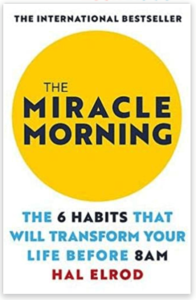
      Hal Elrod’s ‘Miracle Morning’

      A friend first introduced me to this book two years ago.  I was pretty frustrated with my life at that point, feeling I wasn’t really in charge of my life or had any real direction.  When she handed me this book, I devoured it in a couple of days.  To this day, I still recommend it to friends!

      healing curing type 1 diabetes naturally
      Source: Amazon

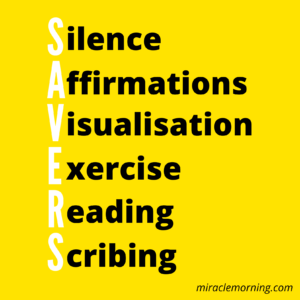
      The book outlines a model for your morning that you can adapt to any timescale you have available (six minutes to two or more hours!).  It is based around six key areas that you focus on each morning, which Hal Elrod calls the ‘SAVERS’:

      healing curing type 1 diabetes naturally

      On top of detailing what to include for each section, Hal gives tips on how to effectively get up in the morning (great for us night owls!) and how to maximise the productivity and profitability of this routine and therefore the rest of your day.

      The Miracle Morning was a really great way for me to start the practice of a morning routine and set me up well for finding what works for me from there.  However, I did struggle with the idea of exercise that early in the morning – I was barely conscious!  I found, as the months went on, my ‘SAVERS’ became ‘SARS’ (yikes!!).  My frustration levels built with my lack of discipline.  So I looked for inspiration elsewhere.

      Adapting The Miracle Morning

      I still really liked the Silence (aka meditation), Affirmations, Reading and Scribing (aka journalling) parts of the Miracle Morning but I was having a couple of issues with them.  Firstly, being a busy wife and mum, I was frustrated by the time limit imposed on me by the demands of my life.  For example, I would get halfway through an amazing chapter in the inspirational book I was reading then realise it was time to get my daughter up for school.  Secondly, as time went on and I read more self-help material, I realised that there were other things that I also wanted to include in my morning routine or do in its place that I couldn’t accommodate in the SAVERS routine.  So I branched out.

      What Is No Longer In My Morning Routine

      The first thing I knew had to go was the exercise.  I have never enjoyed starting my days with exercise.  My body just doesn’t coordinate well first thing in the morning.  On top of that, I have high insulin sensitivity and high glucose sensitivity before 10am, with both increasing by a factor of two.  Chucking exercise into that mix just turns my blood sugar levels into a disaster for the rest of the morning.  So exercise was out.

      I also found the visualisation quite boring and didn’t ever really get into that.  I tried to improve my technique and by reading both ‘Creative Visualization’ by Shakti Gawain and ‘Vivid Visualisation’ by John Freeman.  Despite their stellar Amazon reviews, it just didn’t stick with me.  So, reluctantly, visualisations didn’t make my final list.  (However, I may return to this.  I have just discovered that the highly successful Tony Robbins uses visualisations as part of his morning routine so there must be something in it.  I think there is great power in visualisations, if only I can learn how to harness them.). 

      Affirmations were something else that I removed from my morning routine.  I enjoy using affirmations and feel they really help me to shift my mentality around whatever I focus my affirmations on.  However, I found that I use them most consistently when I attach them to the action of brushing my teeth every morning and evening.  I have stuck my affirmations to my bedroom mirror and repeat them every time I brush!

      My Spiritual Hour

      I now call my routine my spiritual hour because that’s where I want to place my emphasis during the start of my day.  I want the focus to be on my spirituality and practices that support that.  I feel this aligns well with my healing and reflects Dr Kelly Turner’s findings about the importance of spiritual practices in a healing journey.


      Meditation – 20 Minutes

      The first thing I do every morning is meditate.  I tend to do this for about 15 to 20 minutes.  I do different kinds of meditations because I try to choose something that answers whatever I feel my  mind, body and soul need that day.  Sometimes, I will just sit in silence (I actually find this the hardest type of meditation to do…  My, how my mind wanders and my frustration rises!!).  Other times, I might listen to a guided meditation on my laptop.  I’ve accumulated a selection of these over the last few years.  One set I particularly like is an album called ‘Blessing of the Heart’ by Padma Devi Sumananda at Heart of Living Yoga (available here). Other times still, I might follow a particular course that has called to me.  Deepak Chopra’s 21-day meditation challenges are particularly good for that!  These incorporate some learning with some meditation that usually involves a mantra.  I feel particularly zen after these!  Deepak has released some of these for free on YouTube and others are promoted free for limited periods of time through his website.

      Writing

      The next thing I do is a form of writing.  I did feel inspired by Hal Elrod’s suggestion to write and knew that I wanted to keep some form of writing in my spiritual hour.  I just  didn’t like the whole ‘write about what’s on my mind’ thing.  I looked around for ideas to replace this.

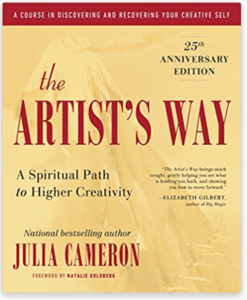
      I have heard really great things about something called ‘The Morning Pages’, which is outlined in Julia Cameron’s book ‘The Artist’s Way’.  Whilst it is outlined as a way to inspire creativity in your life, I know that people use the morning pages for all kinds of levels of exploration.  The idea is that you write  whatever comes into your mind – yes, every word! – for three pages.  It is supposed to bring clarity and inspiration and all host of other amazing things.  Unfortunately, it fell flat with me.  It just seemed a bit pointless.  I did it for a couple of months but didn’t feel I gained anything from it at all.  It just didn’t call to this one’s soul!

      healing curing type 1 diabetes naturallyThe writing practice I eventually landed on was Janet Conner’s ‘Writing Down Your Soul’.  I love this book!!  It gave me a brilliant tool to access my spirituality in a way that felt progressive and fulfilling.  Janet Conner outlines a routine to surround and hold the writing practice.  She also generously gives a whole series of questions you can seek to ask if you are stuck for your own.  

      healing curing type 1 diabetes naturally

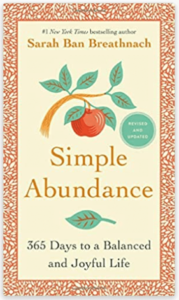
      Janet suggests that, as part of the preparation for writing, you could read something that resonates with you.  The book I chose for this part is Sarah Ban Breathnach’s ‘Simple Abundance: 365 Days to a Balanced And Joyful Life’. This book is truly beautiful.  It consists of 365 passages, one for each day of the year.  I think you are supposed to work through each day in turn throughout the year but, as I bought it half-way through the year, I decided to pick a page at random each day.  Most days, whichever page I land on, it seems to resonate deeply with something in me that is stirring that day.

      So, every morning, that is my writing practice.  After I meditate, I read ‘Simple Abundance’ and then I write to God.  I tell Him (Her?) how I’m feeling and what is going on for me, then I listen for His answers.   They always come.  This writing practice reminds me of what Neale Donald Walsch did in his ‘Conversations with God’.  I hope to benefit from even a fraction of the wisdom that he gained from his experience!

      Prayer

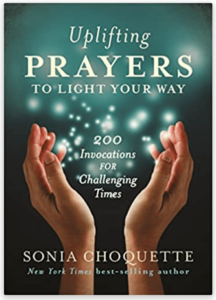
      healing curing type 1 diabetes naturallyAfter writing, I usually pray briefly.  I like to say thanks for all the good in my life and then I select a prayer from ‘Uplifting Prayers to light your way’ by Sonia Chouquette.  This is another book that I really appreciate.  Again, I select a page at random.  More often than not, there is a great synchronicity with the prayer that I find.  It often compliments what I have read in ‘Simple Abundance’ and also often resonates with me.  It really makes me feel close to God as speak the words out that are presented to me.  I feel at peace.

      Other Quick Practices

      Mirror Exercise: I learnt this on the desert retreat I went on last year.  I grab a mirror and, whilst looking directly into my own eyes, I say ‘I see you.  I love you.  You are beautiful.  I am proud of you.’  It is a really affirming process that, whilst feeling awkward at the start, builds over time.  It is a powerful practice to sit with yourself in that feeling.

      Hugging: I finish my spiritual hour by giving myself a good hug.  I discussed in this post about the importance of hugging and how self-hugging can be as effective as hugging someone else.  Every morning, I regulate myself and my body with this quick practice.

      Reiki Principles: As I walk out of the room I do my spiritual practice in, I turn off the light.  I have placed by the light switch the Reiki principles to repeat.  These are:

      healing curing type 1 diabetes naturally

      So that’s it!  That’s my morning routine.

      Of course, there are days I don’t do it.  There are also times when I step away from this practice and do something else.  For example, that happened when I decided to focus last month on my forgiveness practice.  I spent my spiritual hour each morning doing that.  But I always return to this.  It is my home.

      GET HEALINGT1D’S FUTURE ARTICLES IN YOUR INBOX!

      Get the latest musings and findings straight to your email inbox.

        Picture of Natalie Leader
        Natalie Leader

        Natalie is a blogger with Type 1 Diabetes. Natalie’s special gifts are questioning the status quo and being a rebel. She is using these gifts to question medical ‘knowledge’ and find a true cure for Type 1 Diabetes.
        The content of the HealingT1D website is for educational and information purposes only.  It does not contain medical advice. The contents of this website are not intended to substitute for professional medical advice, diagnosis or treatment. Please always consult with your doctor, physician, or other qualified healthcare professional before making any adjustments to your routine or healthcare regime.  HealingT1D and all associated with it will not be held liable for any risks or issues associated with using or acting upon the information on this site.
        Recent Comments:
      • Bedtime Routine

        Bedtime Routine

        A Better End To The Day For Better Healing

        The content of the HealingT1D website is for educational and information purposes only.  It does not contain medical advice. The contents of this website are not intended to substitute for professional medical advice, diagnosis or treatment. Please always consult with your doctor, physician, or other qualified healthcare professional before making any adjustments to your routine or healthcare regime.  HealingT1D and all associated with it will not be held liable for any risks or issues associated with using or acting upon the information on this site.
        healing curing type 1 diabetes naturally

        Summary: Previously resisting structure, the author has finally embraced a bedtime routine for healing. Yoga stretches, skincare, dental care, hydration, gratitudes, and prayer now anchor her evenings. Planning the next day ensures productivity without stress. Fiction reading and experimenting with sound frequencies add relaxation. Candlelight aids skincare, all in pursuit of restful sleep and holistic healing.

        The Bedtime Routine.  I don’t know why I have resisted this concept for such a long, long time.  It could be that it’s because I’m  a night owl.  I love those deeply quiet and restful hours of the early morning when the world is asleep and peaceful.  Or it could be because, as a parent, those few hours after the little ones are asleep seem so short and so full of possibility. 

        Whatever the reason, I resisted and resisted giving my evening hours to something as structured as a ‘routine’.  It felt onerous and long-winded and, well, just hard work at the end of a long day.  But I knew that it was a brilliant  time to be working on healing, rather than my total  number of accumulated telly hours, so I took the plunge.  And, as is my way, I went at it with full force…!

        Designing My Bedtime Routine

        I considered many options for my bedtime routine.  Audiobooks, reading, baths (with or without essential oils, epsom salts and all other kinds of healing products), hydration, reflections on my day, gratitudes, affirmations, yoga, stretching, journalling, diffusing essential oils, facial cleansing routines, drinking herbal teas and so on…! 

        I started to realise that, if I didn’t narrow down my to-do list, I would actually still be awake in the early hours of the morning but, this time, it would be because I was still slogging through my bedtime routine!  I decided to trust my intuition on this and go with what I felt drawn towards.  Some things jumped out at me immediately…

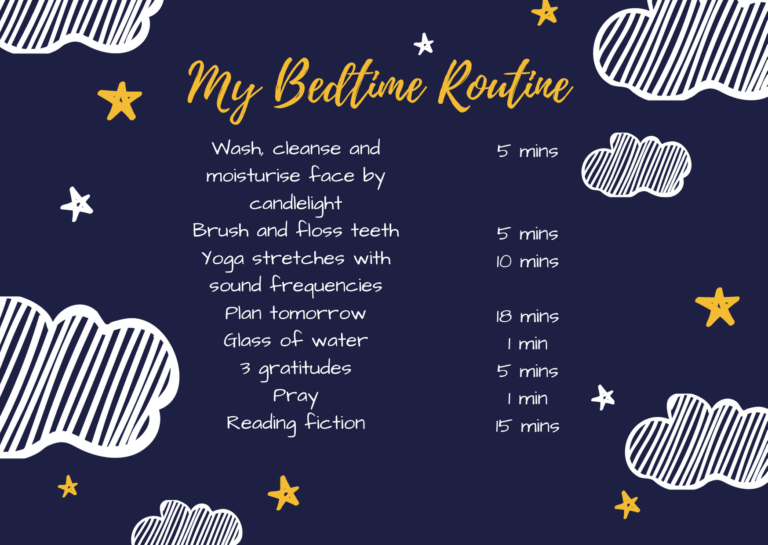
        Yoga Stretches (10 Minutes)

        I felt some yoga stretches before bed sounded great.  I love yoga and always feel restored and relaxed after spending some time on the mat.  However, it’s something I only seem to do sporadically these days so the idea of incorporating that into a daily routine ticked both boxes.  So yoga was in.

        Cleanse, Tone And Moisturise (5 Minutes)

        My appearance, and more importantly how I feel about my appearance, has become more important to me over the preceding months.  I have never really invested in my skin and have always found beauty regimes to be too much effort for too little output.  But a simple cleansing and moisturising routine felt doable.  So that made the list.

        Brush And Floss Teeth (5 Minutes)

        Of course, dental hygiene goes without saying!  I would like to have teeth when I get to old age and diabetics are at increased risk for a whole host of dental problems, including being more prone to gum disease.  As part of my intention to reduce toxins in my life, I considered using herbal toothpaste.  I actually started this and bought a well-known brand.  However, within three months of using this, I was found to have my first ever filling.  Perhaps coincidence, perhaps not.  But I didn’t want to risk any more problems so I’ve scrubbed that idea and gone back to standard toothpaste.  So…  Teeth brushing (with a standard toothpaste!), check.  Flossing, check.

        A Glass Of Water (1 Minute)

        Hydration.  So, as you know, I now live in an extremely hot desert climate so hydration is on my mind at all hours!  I never used to drinking water at night because it often disrupted my sleep due to much needed loo break.  However, out here, I am now waking up each morning feeling very thirsty and that doesn’t create a good bodily environment for healing.  A glass of water is now part of my night-time ritual.

        Gratitudes (5 Minutes)

        I tried to make a gratitude practice part of my morning routine but I struggled to name lots of things I was grateful for when I’d just staggered out of bed!  I always seemed able to remember to be grateful for my sleep but that was about it!!  I hope that, by making this part of my evening routine, I will be able to reflect on my day and all the wonderful moments in it.  I hope it will therefore strengthen and deepen my gratitude practice.  For now, I will start with three gratitudes every night.

        Prayer (1 Minute)

        How much did I resist prayer in my life??  Wow, it has hardcore!  For years, I didn’t want to pray to a god that I felt had cursed me with diabetes.  I didn’t feel He/She deserved as much as a hello from me!  I think that the addition of prayer into my night-time routine shows just how far I have come on my healing journey already.  I don’t have any set format for praying.  I just treat it as a time for me and God to talk, for me to say whatever’s on my mind and, when I can, offer gratitude for all that He/She has done for me and given me.

        Plan For The Next Day (18 Minutes)

        i have been getting more into self-development lately and I have heard again and again the phrase ‘those who fail to plan, plan to fail’.  I don’t know how much that is true but I do know that, on the days that I have made a plan for my time, I get a whole lot more done than on the days when I don’t plan.  So planning is in there.  But please note that this is not an all-out plan-every-minute kind of thing.  It’s more ‘these are the things I want to get done and what is the best order I can do it in’.  If I plotted every minute of my day, I dissolve into a stress heap when I got five minutes behind schedule.  That isn’t good for creating a stress-free environment for my healing to take place!

        Reading Fiction (15 Minutes)

        Ah, reading!  I love reading!!  I have found that, as my healing journey continues, I seem to be devoting more and more of my time to reading factual books about healing.  Consequently, less and less of my time is devoted to reading fiction.  I feel the balance between work and play is important in life so time needs to be made for enjoyment and relaxation.  Reading fiction answers this call for me.  Moreover, a gentle story sets me up well to drift off into the land of nod so I have added 15 minutes of reading fiction to my plan.

        Finishing Touches

        Once I’d worked out what I wanted to include in my bedtime routine, I then had to figure out how long to allocated to each item (see above).  I didn’t want to spend more than an hour on my routine so I allocated that hour according to how long I felt each activity would realistically take.  I might have to adjust as time goes on.

        Then, the last thing to do was decide the order of the activities.  I decided I would start in my bathroom as this was the furthest from my bed.  That meant doing my ‘cleanse, tone and moisturise face’ and ‘brush and floss teeth’ first.  I followed those with my yoga stretches in my bedroom, since these needed to be completed before I could get into bed.  Then, from the comfort of my bed, I chose to plan my day first.  I knew that this activity would wake my brain up a bit and I needed to save some more calming, less engaging activities for after that.  I therefore follow my planning with my glass of water, gratitudes and prayer.  I complete the routine with reading my fiction book for fifteen minutes and then turn the light off.   Job done!  Night night, sleep well.

        healing curing type 1 diabetes naturally

        A Couple Of Extra Things

        You might have noticed that I have added candlelight to my skincare routine and sound frequencies to my yoga stretches.  The reason for the candlelight is due to something I read in the book ‘Sleep by Nick Littlehales’.  He discusses the importance of avoiding bright light on the run-up to bedtime.  I really recommend that book if you need to improve the quantity and/or quality of your sleep!

        The reason for the sound frequencies is a little less delineated in my mind.  I have been hearing great things about the healing qualities of sound frequencies and so I have started to experiment with solfeggio frequencies.  Because of the link diabetes has to past trauma and the solar plexus chakra, I am focussing on the frequency of 417 Hz.  At the moment, the only time I play solfeggio frequencies is during these ten minutes that I’m doing my bedtime yoga  poses.  But it’s a start!

        GET HEALINGT1D’S FUTURE ARTICLES IN YOUR INBOX!

        Get the latest musings and findings straight to your email inbox.

          Picture of Natalie Leader
          Natalie Leader

          Natalie is a blogger with Type 1 Diabetes. Natalie’s special gifts are questioning the status quo and being a rebel. She is using these gifts to question medical ‘knowledge’ and find a true cure for Type 1 Diabetes.
          The content of the HealingT1D website is for educational and information purposes only.  It does not contain medical advice. The contents of this website are not intended to substitute for professional medical advice, diagnosis or treatment. Please always consult with your doctor, physician, or other qualified healthcare professional before making any adjustments to your routine or healthcare regime.  HealingT1D and all associated with it will not be held liable for any risks or issues associated with using or acting upon the information on this site.
          Recent Comments:
        • NEWSFLASH!

          NEWSFLASH!

          The Fight-Flight Response Is Connected To Beta Cell Creation And Destruction

          The content of the HealingT1D website is for educational and information purposes only.  It does not contain medical advice. The contents of this website are not intended to substitute for professional medical advice, diagnosis or treatment. Please always consult with your doctor, physician, or other qualified healthcare professional before making any adjustments to your routine or healthcare regime.  HealingT1D and all associated with it will not be held liable for any risks or issues associated with using or acting upon the information on this site.
          healing curing type 1 diabetes naturally

          Summary:  Recent research confirms a link between the autonomic nervous system (ANS) and pancreatic beta cell function in Type 1 Diabetes (T1D), validating the impact of stress and distress on beta cell destruction and regeneration. Addressing chronic stress and promoting relaxation may potentially aid beta cell regeneration in T1D management.

          The Relationship Between The Autonomic Nervous System And The Pancreas

          Wow, wow, wow!  I have just come across a research article that has blown my mind and I just had to share it with you!

          I found an article in the scientific literature that has confirmed a hunch I have about the development (and maintenance) of Type 1 Diabetes.  The article is entitled ‘Relationships between the Autonomic Nervous System and the Pancreas including Regulation of Regeneration and Apoptosis: Recent Developments’.  It can be found in the  journal ‘Pancreas’ (find the article here) . Fun title, eh?!  Haha!

          First, just a quick glossary for those that need it (like I did about ten minutes ago!!):

          Regeneration = creation of new cells

          Apoptosis = cell death

          What is so amazing for me about this article is that it has confirmed to me for the first time in the scientific literature that there is a link between the fight-or-flight response of the autonomic nervous system and the creation and destruction of insulin-producing cells in the pancreas.  MY INTUITION WAS RIGHT!! As I suspected…  

          Therefore, I am right to believe that sufficient trauma can result in destruction of insulin-producing cells, which would result in the development of T1D.  Then, if the body gets stuck in a fight-or-flight response – either it doesn’t process that the trauma has passed OR the trauma is ongoing or chronic – the status of T1D is maintained in the body.  

          In other words, the body continually tells the pancreatic cells to stayed destroyed and not be regenerated because the autonomic nervous system is saying that there is something dangerous out there that the body needs to be ready for.  So now the question becomes…  If I find a way to tell the body (and mind and soul) that the threat is over and I am now safe, will the pancreas then regenerate beta cells and thus start producing insulin again?

          GET HEALINGT1D’S FUTURE ARTICLES IN YOUR INBOX!

          Get the latest musings and findings straight to your email inbox.

            Picture of Natalie Leader
            Natalie Leader

            Natalie is a blogger with Type 1 Diabetes. Natalie’s special gifts are questioning the status quo and being a rebel. She is using these gifts to question medical ‘knowledge’ and find a true cure for Type 1 Diabetes.
            The content of the HealingT1D website is for educational and information purposes only.  It does not contain medical advice. The contents of this website are not intended to substitute for professional medical advice, diagnosis or treatment. Please always consult with your doctor, physician, or other qualified healthcare professional before making any adjustments to your routine or healthcare regime.  HealingT1D and all associated with it will not be held liable for any risks or issues associated with using or acting upon the information on this site.
            Recent Comments:
          • MORE Spontaneous Remissions from Type 1 Diabetes!

            MORE Spontaneous Remissions from Type 1 Diabetes!

            History Is Scattered With Examples Of Healing From Type 1 Diabetes

            The content of the HealingT1D website is for educational and information purposes only.  It does not contain medical advice. The contents of this website are not intended to substitute for professional medical advice, diagnosis or treatment. Please always consult with your doctor, physician, or other qualified healthcare professional before making any adjustments to your routine or healthcare regime.  HealingT1D and all associated with it will not be held liable for any risks or issues associated with using or acting upon the information on this site.
            healing curing type 1 diabetes naturally

            Summary: Following my blog post on the spontaneous healing of Type 1 Diabetes by Daniel Darkes, the author has found more examples.  These include that of Johan Kotze’s remission, alongside a case study published in an academic journal and a chapter about healing diabetes in a book on spontaneous remissions. Despite gaps in medical documentation, these instances inspire hope and challenge conventional treatment beliefs about healing T1D.

            Since writing my blog post on Daniel Darkes, I have witnessed a large amount of you visiting my blog specifically to look at that page.  It heartens  me to see just how many people believe in the power of healing, particularly for Type 1 Diabetes.  Hoping to further fuel this hope and motivation, I have scoured all my sources to come up with a further list of spontaneous remissions from Type 1 Diabetes.  It appears that Daniel Darkest is not alone in this feat!

            Just to explain…  I have omitted any case studies of remission that, for me, could be considered the normal honeymoon phase of Type 1 Diabetes.  The honeymoon is a fairly robust phenomenon in the development of T1D, where endogenous insulin production reverts to more normal levels after the initial diagnosis of T1D.  This period usually last for a few weeks or months, up to a year.  Therefore, I have excluded all cases that went into remission in under a year from diagnosis.

            Johan Kotze

            I came across information about Johan Kotze from diabetes.co.uk.  In September 2017, they published this article.  The article has a good amount of information on Johan Kotze’s spontaneous remission and lifestyle at that time.  Johan Kotze was 46 when diagnosed with diabetes and was healed three and a half years later.  

            There were three key points for me in this example.  Firstly, like Daniel Darkes, Johan Kotze also treated his diabetes with Lantus and Novorapid.  Secondly, again like Daniel Darkes, Johan’s spontaneous remission followed a period of intensive exercise, which included undertaking a Tough Mudder and attending weekly circuit classes.  He still exercises for at least an hour a day and has been maintaining that level of exercise for at least three years.  Thirdly, also like Daniel Darkes, he follows a low-carbohydrate diet with a lot of fish, vegetables and salad.  He mentions eating flaxseed.  Daniel Darkes eats a fair amount of nuts.

            Spontaneous Complete Remission Of Type 1 Diabetes Mellitus In An Adult

            This case study has been published in a peer-reviewed journal so holds some credence.  It documents the case of a 32-year-old female diagnosed with T1D.  She initially presented with diabetes ketoacidosis (DKA) and an HbA1c of 12.7%.  Her GAD65 antibody test was 0.09 nmol/L, which is consistent with the autoimmune reaction of T1D.    After an initially consistent basal-bolus regimen (insulins are unspecified) for four months, she was detained in prison.  For reasons that are unclear, she was not supplied with insulin whilst in prison.  However, she did not develop high blood sugars or DKA.  Ten months later, 14 months after diagnosis, she was released from prison and followed up with her doctor.  Her HbA1c was 5.6% and her fasting glucose was in the normal range.

            Spontaneous Remission: An Annotated Bibliography By Brendan O’Regan And Caryle Hirshberg

            This volume is a tome of a book!!  This book contains an extensive documentation of spontaneous remissions for all known medical diseases.  Chapter 12 focuses on remissions of endocrine diseases, inter alia, and contains four case studies for diabetes mellitus.  Now the thing to note here is that diabetes mellitus can refer to both Type 1 and Type 2 diabetes.  This book does not clearly label which type of diabetes each case study had so any conclusions drawn from this volume for Type 1 Diabetes can only be tentative.  Furthermore, the case studies show relatively short periods of diabetes (between a few days and maximum two years) so I am not sure that these can be truly classified as complete remissions of Type 1 Diabetes.

            I suspect that this list is a mere fraction of the amount of spontaneous healings from T1D.  From my interest in spontaneous remissions from cancer, I got the impression that the majority of people who recover are those that no longer rely solely on the Western medical model or indeed do not engage with it at all.  Therefore, the likelihood of the healing appearing in a medical journal, written by medical professionals, is pretty low.  For those that do present in medical settings, I suspect that doctors will also not be particularly willing to write up these examples because they cannot explain them using the existing medical models.  Writing the case studies up therefore undermines the doctors’ very training.

            Whether or not we witness numerous examples of healing form Type 1 Diabetes in the literature, the cases of Daniel Darkes and Johan Kotze are, in themselves, sufficient to persuade us that it is possible.  And that’s really all I kneed to know to get on with my healing journey!

            GET HEALINGT1D’S FUTURE ARTICLES IN YOUR INBOX!

            Get the latest musings and findings straight to your email inbox.

              Picture of Natalie Leader
              Natalie Leader

              Natalie is a blogger with Type 1 Diabetes. Natalie’s special gifts are questioning the status quo and being a rebel. She is using these gifts to question medical ‘knowledge’ and find a true cure for Type 1 Diabetes.

              The content of the HealingT1D website is for educational and information purposes only.  It does not contain medical advice. The contents of this website are not intended to substitute for professional medical advice, diagnosis or treatment. Please always consult with your doctor, physician, or other qualified healthcare professional before making any adjustments to your routine or healthcare regime.  HealingT1D and all associated with it will not be held liable for any risks or issues associated with using or acting upon the information on this site.
              Recent Comments:
            • Dairy Causes Mental Health Issues

              Dairy Causes Mental Health Issues

              Food Choices Can Impact All Levels Of Health

              The content of the HealingT1D website is for educational and information purposes only.  It does not contain medical advice. The contents of this website are not intended to substitute for professional medical advice, diagnosis or treatment. Please always consult with your doctor, physician, or other qualified healthcare professional before making any adjustments to your routine or healthcare regime.  HealingT1D and all associated with it will not be held liable for any risks or issues associated with using or acting upon the information on this site.
              healing curing type 1 diabetes naturally

              Summary: Discovering a dairy intolerance at the age of 41 reshaped my understanding of its effects beyond digestion. After moving to the Middle East, reducing my dairy intake lowered my mood swings and energy dips, thus revealing a surprising link between dairy and emotional stability. Exploring casein’s role, I ponder its broader implications, including its possible influence on Type 1 Diabetes. Camel’s milk emerges as an alternative with unique benefits but watch for initial blood sugar spikes and potential weight gain.

              I LOVE chocolate.  And a nice french brie.  And milk on my cereal.  And…  Well, dairy!!  

              However, the last couple of months have been a great learning curve for me.  At 41 years of age, I have FINALLY discovered that I’m dairy intolerant!  It would have been nice to discover I’m a secret millionaire but I guess I’ll have to settle for this insight instead!!

              Unlike the majority of people who have issues with dairy, I have little to no digestive problems.  I have no bloating, no diarrhoea, no nausea, no stomach cramps or pains.  In fact, my digestive tract always appears to be sincerely contented.  What was not contented, though, was my mood…

              Dairy Impacts Mood Stability

              healing curing type 1 diabetes naturallyDairy affects my mood?!  I never knew this!!  When I moved to the Middle East six months ago, the amount of dairy in my diet dropped considerably.  I just didn’t find it so readily available out here.  I didn’t really notice how little of it I was eating until I moved into our new home and started reverting to my old way of eating.  And, boy, did I get angry…  And moody…  And crabby…  And exhausted…  And tearful…  And snarky…  And, frankly, depressed.

              But was this really a thing??  Having family members with debilitating IBS, which was always worse with dairy consumption, I thought I knew all there was to know about reactions to dairy.  But it turns out that I didn’t know!  So I did what all people lacking knowledge do… I hit Google!!  And here is what I discovered…

              Dairy’s Impacts On The Brain

              The first thing I tripped across in my Google search was an article in the New York Post entitled “Your cheese addiction could be making you an emotional wreck“.  It referenced a nutritional therapist Kay Ali, who stated that the protein ‘casein’, which is found in dairy, is associated with increased inflammation in the brain.  This inflammation can then lead to depression.  

              I found this insight really interesting.  The article did not reference any academic literature so I took to the academic journals to find out more.  Unfortunately, I could not find anything to support this conclusion.  Instead, I found an article suggesting that milk casein can improve stress in a mouse model of human behaviour.  So the jury’s out on the association between dairy, inflammation and depression  at the moment.

              Whilst unsupported, this article did give me food for thought (pun intended!).  My experience of mood swings as a result of eating dairy foodstuffs is not isolated.  Anecdotal evidence of this link abounds with bloggers like ‘Danny + Mara‘ and Heather McGlees from ‘One Green Planet’ also highlighting the same issue.

              I thought I had been suffering from unexplainable anxiety and depression for years.  I would be feeling that I was making progress, feeling better and more optimistic about myself and life, then my mood would inexplicably crash down around my ankles again.  It was hard, hard work.  I attended therapy for years and worked on myself, both inside and outside the therapy room, for a long time.  But this unpredictable oscillation in mood never abated and I ended up concluding that it must just be some randomness in me that I just needed to learn to live with.  That is not the case for me anymore.  I have done my therapeutic work and I have untied the knots in my psyche.  Now that I have this final piece of the puzzle, I no longer consider myself to have mental health issues.  I can now say (and truly believe myself when I say it!!) that I am ‘mentally healthy’ (even though I hate labels!!).

              A1 Beta-Casein And Type 1 Diabetes

              The nutritional therapist Kay Ali (referenced above) specifically mentioned that it is the protein ‘casein’ that is associated with increased inflammation, and therefore depression, in the brain.  This is worth repeating  for emphasis because I think it holds something highly valuable for me on my healing journey. 

              I first learnt about casein when I became pregnant with my daughter in 2013.  At that time, I researched factors that may affect the potential development of Type 1 Diabetes in children.  Type 1 Diabetes has a strong genetic inheritance in the female side of my family so I wanted to do what I could to prevent and/or delay any onset in my daughter.  I found a series of articles that highlighted how the protein A1 beta-casein, found in cow’s milk, can be a triggering factor for T1D in individuals with genetic susceptibilities [see this article  and this article as examples].  Therefore, for the first six months of my daughter’s life, I gave her no dairy, neither through my breast milk nor through top-up feeds of formula milk (I found a dairy-free version to give her instead).

              Encountering casein in a different yet still T1D-relevant context now leaves me wondering about a potential, more general link between dairy intolerance (A1 beta-casein intolerance…?) and T1D.  Is my body telling me to lay off the dairy because of a body-wide intolerance to it…?  As of now, I just don’t know the answer to this.  But I do know that dairy does not suit me, so the avoidance of it in my diet makes sense to me anyway.

              BONUS: Camel Milk!

              healing curing type 1 diabetes naturally
              Image by Pete 😀 from Pixabay

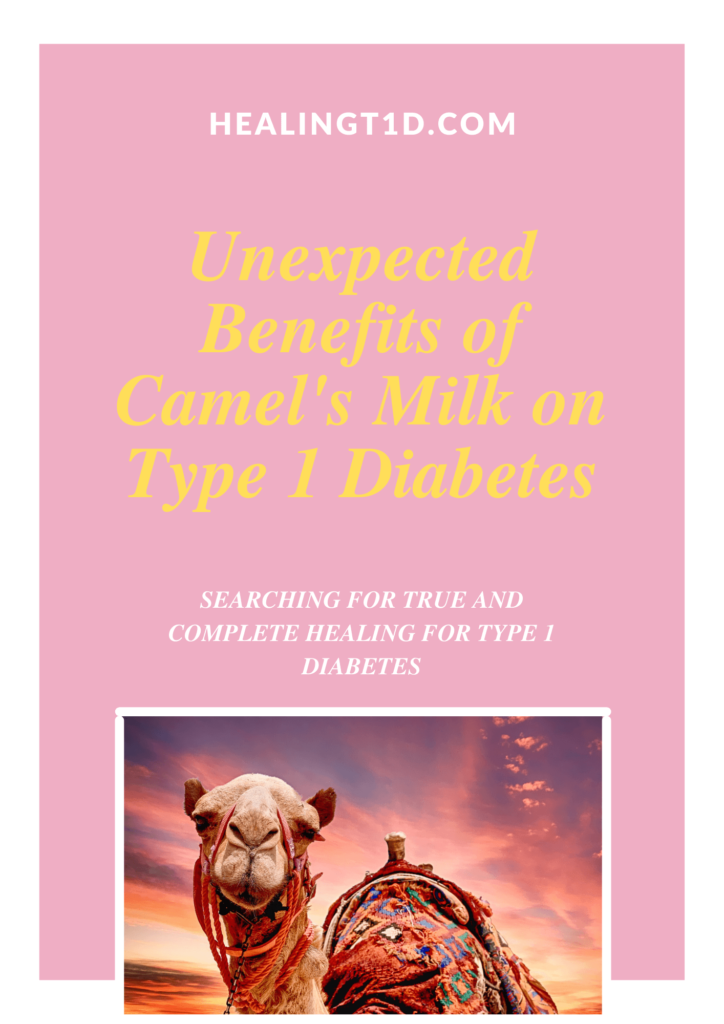
              So what if you are thinking of giving up cow’s milk but you really, really like a cup of tea or coffee with milk?  Or if you can’t do without that bowl of cereal and milk in the morning?  I have an answer  for you…  Camel’s milk!

              Camel milk lacks the beta-casein that cow’s milk contains.  So this is a great substitute for avoiding the whole beta-casein issue.  But, the superpowers of camel’s milk seem to also go beyond this…

              Agrawal and colleagues have undertaken extensive research on the impact of camel’s milk on glycaemic control for patients with Type 1 Diabetes.  They have found that camel’s milk is safe and can be used to improve long-term glycaemic control, as evidenced by improved HbA1c’s and reduced doses of insulin (see herehere, and here!).  It appears that this may be attributable to the fact that camel’s milk contains protein that have a structure similar to insulin molecules and this similarity may be responsible for the significant impacts on blood sugar levels.  Furthermore, for new Type 1 Diabetics, consumption of camel’s milk seemed to aid the maintenance of residual beta-cell function.

              What I found particularly interesting was, in this study, it was found that C-peptide levels (used by doctors as an indication of type 1 diabetes – a low level indicates a Type 1 Diabetes diagnosis) were markedly higher in subjects who regularly consumed camel’s milk.  In fact, those T1Ds that consumed camel milk had, by the end of 16 weeks, C-peptide levels that were equivalent to non-diabetics!!

              And all this was achieved purely by drinking 500 ml of camel’s milk per day.  Not bad, eh?!

              Words Of Warning…

              With such beneficial effects appearing achievable with camel’s milk, I thought I would give it a go.  I have to say that, for the first few days, my blood sugars SOARED with the addition of camel’s milk in my diet.  Whilst it may have good long-term consequences for diabetes management, in the short-term, it has been playing havoc with my blood sugar control.  This has meant I have had to increase my insulin doses.  I hope, as time goes on, I will start to witness the build-up of beneficial effects but these early days have no been without consequences!  The studies appeared to be undertaken over periods of three months or longer so I wonder if this may be more of a long-term effect.

              Furthermore, I noticed that a large number of these studies on camel’s milk showed a statistically significant increase in the Body Mass Index (BMI) of the study participants.  Therefore, the extra calories consumed with the camel’s milk appear to cause weight gain.  This has left me with two thoughts.  Firstly, this is obviously not ideal when I want to decrease my insulin requirements since excess weight increases insulin resistance and therefore is unlikely to regress complete healing. 

              Secondly, these studies, whilst demonstrating weight gain in the participants, still showed a marked decrease in total insulin intake.  Therefore, even with additional weight gain, camel’s milk (assuming all other variables, such as the Hawthorne Effect, were adequately controlled for) drastically improves insulin sensitivity.  That suggests to me that it has a very robust and extremely powerful effect on blood sugars.  Therefore, I am starting with smaller quantities of camel’s milk and will be working up to consuming the full 500 ml per day.

              healing curing type 1 diabetes naturally
              healing curing type 1 diabetes naturally

              GET HEALINGT1D’S FUTURE ARTICLES IN YOUR INBOX!

              Get the latest musings and findings straight to your email inbox.

                Picture of Natalie Leader
                Natalie Leader

                Natalie is a blogger with Type 1 Diabetes. Natalie’s special gifts are questioning the status quo and being a rebel. She is using these gifts to question medical ‘knowledge’ and find a true cure for Type 1 Diabetes.

                The content of the HealingT1D website is for educational and information purposes only.  It does not contain medical advice. The contents of this website are not intended to substitute for professional medical advice, diagnosis or treatment. Please always consult with your doctor, physician, or other qualified healthcare professional before making any adjustments to your routine or healthcare regime.  HealingT1D and all associated with it will not be held liable for any risks or issues associated with using or acting upon the information on this site.
                Recent Comments:
              • How Did You Develop Diabetes?

                How Did You Develop Diabetes?

                Sharing Knowledge Helps Everyone Heal

                The content of the HealingT1D website is for educational and information purposes only.  It does not contain medical advice. The contents of this website are not intended to substitute for professional medical advice, diagnosis or treatment. Please always consult with your doctor, physician, or other qualified healthcare professional before making any adjustments to your routine or healthcare regime.  HealingT1D and all associated with it will not be held liable for any risks or issues associated with using or acting upon the information on this site.
                healing curing type 1 diabetes naturally

                Summary: Seeking to uncover shared insights among those with diabetes, I invite stories on diabetes origins and emotional climates at diagnosis. Reflecting on my own childhood and familial dynamics, I explore possible emotional triggers. Join me in building a collective understanding of this condition’s roots and potential pathways to healing. Share your story below.

                I truly believe that, as a community of diabetics, we have the collective knowledge to be able to heal this condition.  I believe we already have the answer, if only we truly look at what we already know.

                With that thought in mind, I would really like to start collating the stories of diabetes.  How did you develop it?  What does your intuition say caused it?  As I’ve been reading more and more on the human body and the impact of consciousness, I would also really like to know about the emotional climate that you were in at the time it happened.  What were you feeling?  Which emotions were floating around your environment at the time?  What is your story?

                If you feel able to share, please do so below in the comments.  I will then watch out for themes and see if I can gather more clues on the pattern or patterns that push diabetes into existence in each of us.

                I’ll go first…  

                I was diagnosed with diabetes at 17 months of age.  I had been a healthy baby with generally robust health prior to my diagnosis.  I was born into a family with an older brother and my two parents, who were married and provided a stable family environment.  My father had a stable job with fairly long hours but was a present and loving father.  My mother also worked part-time as a secretary from home and had to return to that job two weeks after I was born.  I know that my mother found it difficult to juggle my older brother, myself and her work.  By the time I was one year old, she was struggling greatly and therefore couldn’t be present as a mother as much as she wanted to.  I suspect that, as such a young child, I would have felt abandoned and angry and feeling a great loss at the relative absences of my hard-working mother and father.  I did not suffer any huge traumas at that time.  However, I do know that my mother had suffered a huge loss when she was 17 months of age, which I believe was never fully processed.  As such, I am also wondering about the impact of multigenerational traumas in this process too.  

                I’d love to hear your stories!  What elements do we all share?  If you can, please leave your story below in the comments and let’s build the answer together…

                GET HEALINGT1D’S FUTURE ARTICLES IN YOUR INBOX!

                Get the latest musings and findings straight to your email inbox.

                  Picture of Natalie Leader
                  Natalie Leader

                  Natalie is a blogger with Type 1 Diabetes. Natalie’s special gifts are questioning the status quo and being a rebel. She is using these gifts to question medical ‘knowledge’ and find a true cure for Type 1 Diabetes.

                  The content of the HealingT1D website is for educational and information purposes only.  It does not contain medical advice. The contents of this website are not intended to substitute for professional medical advice, diagnosis or treatment. Please always consult with your doctor, physician, or other qualified healthcare professional before making any adjustments to your routine or healthcare regime.  HealingT1D and all associated with it will not be held liable for any risks or issues associated with using or acting upon the information on this site.
                  Recent Comments:
                • Healing Attention Deficit Disorder

                  Healing Attention Deficit Disorder

                  Green Tea, Classical Music and Walks In Nature

                  The content of the HealingT1D website is for educational and information purposes only.  It does not contain medical advice. The contents of this website are not intended to substitute for professional medical advice, diagnosis or treatment. Please always consult with your doctor, physician, or other qualified healthcare professional before making any adjustments to your routine or healthcare regime.  HealingT1D and all associated with it will not be held liable for any risks or issues associated with using or acting upon the information on this site.
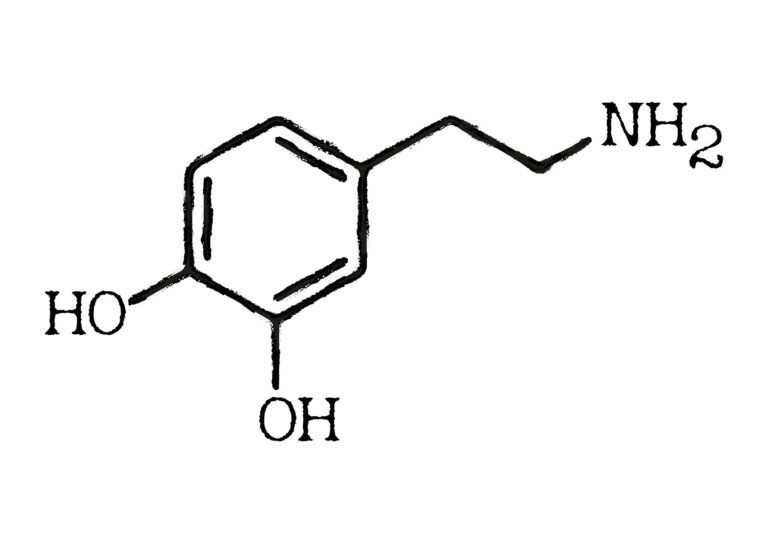
                  The Hormone and Neurotransmitter Dopamine
                  The Neurotransmitter Dopamine

                  Summary: The author explores how dopamine fluctuations, resulting from swinging blood sugars, impacts her ADHD-like symptoms. She links insulin levels to dopamine regulation, noting sugar’s role in affecting mood and motivation. To heal her ADHD symptoms naturally, the author adopts green tea for dopamine, classical music for focus, and nature walks for exercise and emotional balance.

                  I’m having one of those diabetes days…  As I’m sitting here trying to write this, my blood sugars keep dropping.  Oh, but wait…  They’re up, they’re in range!  Oh nope, they’re not.  Down again.  Yep, yep, got them up… Oh no, I haven’t!  Ah, made it!  At last, I’m back on point…!!  So, anyways…  Back to Healing ADD!

                  As I discussed in my last blog post, I believe that I’ve got Inattentive ADD (although I’ve not been officially diagnosed with it).  Dr. Amen discusses in his book ‘Healing ADD’ how ‘dopamine is generally considered the neurotransmitter involved in Inattentive ADD’ (Amen, 2013 p. 104).

                  What Is Dopamine?

                  The classic introduction to Dopamine usually includes a spiel about how it is a neurotransmitter, how it works in the brain to enable a person to focus and how it gives a person motivation, desire and drive to achieve a task.  Even this preliminary information is still useful to me.  Taking Dr Amen’s view that dopamine is involved in ADD, it is easy for me to understand why my motivation is erratic at best and completely absent at worst.

                  The Other Side Of Dopamine

                  Knowing that dopamine is impacting my motivation towards healing is all well and good but, for me, that isn’t the full picture.  As I already discussed in my post on Candace Pert’s neuroscientific work, there is no clear distinction between the ‘neurotransmitters’ of the brain (which Dopamine is classed as) and the ‘hormones’ of the body.  Instead, our body consists of peptides that link communication and action between the nervous, endocrine and immune systems.  Indeed, researchers now seem to be garnering support for Candace Pert’s theory…

                  The Link Between Insulin And Dopamine

                  I was interested to find a preliminary study conducted in 2007 by a group of researchers at the Vanderbilt University Medical Center that identified insulin as having an important role in the dopamine pathways in the brain

                  This study showed that, when insulin levels are low in the brain (which occurs when a diabetic has high blood sugar levels), the dopamine pathways in the brain is unable to produce normal levels of dopamine.  I would therefore anticipate that, when a diabetic has higher than non-diabetic blood sugar levels (which occurs for most diabetics after every carbohydrate-based meal), dopamine is suppressed and ADD symptoms are likely to be present.

                  So, as a diabetic with unnaturally oscillating blood sugars, it’s a double whammy.  If my blood sugars are out of whack, my dopamine levels are too and my motivation goes down the plughole.  So then trying to get motivated to get my sugars back in range is all that bit harder!  So how do I square this circle??

                  Sugar And ADD

                  healing curing type 1 diabetes naturally
                  Sugar Can Give A Quick Boost To Dopamine Levels But Can Leave Naturally Occurring Dopamine Levels Depleted in the Longer Term [Image by Myriam Zilles from Pixabay]
                  I believe that, the majority of time, my dopamine must be depleted.  I spend more of my time lacking in enthusiasm and energy, rather than hyperactive and overzealous (although that does occasionally happen too!).  Something I also contend with on a daily basis is my cravings for sugar.  I crave sugar all the time!  And now I understand how these two facts are related…

                  Sugar provides an exogenous method for increasing dopamine levels in my system.  When I eat something sugary, my brain lights up with increased dopamine levels and I get back in my groove.  So every time I reach for a piece of chocolate, a slice of cake or some other sugar-rich food, I am finding a way to increase my depleted dopamine levels.  But each additional sugar feeding also leads to weight gain.  Indeed, it has been found that obese people have a five to ten times increased rate of ADHD than the general population.

                  As if that isn’t bad enough, each time I eat sugar, I am increasing dopamine levels in my system artificially, by outside means.  Therefore, my brain is learning that it needs to make less dopamine endogenously because the sugar will be along soon to increase dopamine again.  And so the vicious cycle begins…  Dopamine levels are low in my brain, my system waits for the sugar, I eat the sugar, my brain learns it doesn’t need to manufacture its own and therefore makes even less!

                  How Can I Heal My ADD Naturally?

                  If I can find a way to naturally increase my dopamine levels, then my ADD is (or at least its symptoms are) likely to reduce or disappear.  Having just discussed the benefits of removing sugar (something I did successfully during my Whole30 challenge), eliminating sugar in my diet seems like an obvious first step.  But my intuition is saying no to this.

                  I have eaten a low-carbohydrate diet for periods of my life with success but the longest I have ever achieved was seven months.  Then, Christmas came along and the deprivation I felt at not being able to eat the foods I loved was too great.  Every time I have tried to eat low-carb since then, the same thing always happens.

                  In order to achieve great healing, both physically and emotionally, I personally need to do something that does not feel so punitive or restrictive to me.  Please don’t misunderstand me…  I know of several diabetics that are hugely successful long-term with low-carbohydrate eating and it brings great quality to their lives.  I have great respect for their way of life.  But I also believe that healing is a very individual journey and you have to respond to what feels right for you as an individual.  I know that I need an alternative to low-carbing.

                  healing curing type 1 diabetes naturally
                  Low-Carbing Can Be Very Effective for Blood Sugar Control, But It’s Not Right For Me! [Image by RitaE from Pixabay]

                  Initial Steps To Healing My ADD

                  I have a tonne of ideas about where to start with healing my ADD.  But, if I’ve picked anything at all up from my reading in this area, I really think, for now (and ever after!), I need to start small.  My usual plan is to go in with everything at the same time and then give up or stop with exhaustion within a month. 

                  The Journey of A Thousand Miles Begins With A Single Step

                  And most importantly…

                  What can I commit to now that I will be able to continue to do in the future?

                  To work out what to do to heal my ADD, I want to tap into my intuition, my inner wisdom.  I am sure that my path to healing is already known within me, I just have to listen to it.  For now, I am going to focus on only three simple things.  These are my first three steps on a road of a thousand miles…

                  1. Green Tea

                  healing curing type 1 diabetes naturally
                  Green tea contains the amino acid L-Theanine, which is a building block for dopamine in the brain. [Image by Owen Carver from Pixabay]

                  My gut instinct is still telling me that Kelly Turner’s research (see my post here) has tapped into the inherent mechanism by which the body heals from any health issue, not just cancer.  So I wish to try to use her strategies where possible.  Therefore, a first easy step for me is to take follow her protocol to take some herbs and/or supplements.  But which ones?

                  I want to start small yet consistent and I feel that a cup of green tea each morning, before I have breakfast, fulfils those requirements.  Green tea contains the amino acid L-theanine.  L-theanine not only has a direct effect on your mental alertness, enabling your to relax, but L-theanine is also a building block for dopamine in the brain.  All from a good old cup of tea! 

                  2. Listen To Classical Music

                  healing curing type 1 diabetes naturally
                  Listening to Classical Music Increases Dopamine Levels in the Brain [Image by Jiradet Inrungruang from Pixabay]

                  I found a piece of  neuroscientific research that found that  classical music increases dopamine production in the brain.  

                  I am not an expert on classical music, let alone its effects on my brain(!), so I was unsure which pieces of classical music should be on my playlist.  Thankfully, the experts over at the ADDitude blog have already put together a list of suitable music!  

                  I have uploaded it onto Spotify as a playlist and called it ‘Classical Music for ADHD’.  I am going to hit the play button for 30 minutes every weekday morning as I get ready for my day and hopefully my dopamine levels will rise beautifully!

                  3. Get Out In Nature

                  healing curing type 1 diabetes naturally
                  Walking in Nature Increases Dopamine Levels Both Through the Exercise And Also Through The Environment [Image by Valiphotos from Pixabay]

                  I love nature and really don’t need any excuse to get out in it!  Life is always busy and I guess I don’t prioritise doing this as much as I would like to.  This one is on my list of action items for multiple reasons.

                  Firstly, I feel good in nature.  Kelly Turner emphasises the need to increase positive emotions and reduce negative emotions as part of your healing journey.  Nature does this for me.

                  Secondly, multiple studies highlight the direct link between exercise and increased dopamine levels.  So walking in nature also ticks this box.

                  Thirdly, this one feels so intuitively right (although, at the moment, it’s a sweltering 30-degrees plus out my window and a part of me just wants to run and hide in a deep freezer rather than go out and walk!!).  Therefore, I am going to commit to walking for at least 15 minutes in nature five days each week.  Ideally, I would like to do 30 minutes but I want to make sure it is achievable rather than setting myself up to fail.

                  A Helping Hand…

                  healing curing type 1 diabetes naturally
                  Until My Natural Dopamine Levels Have Re-Established Themselves, I Will Reach Out To Others’ For Help and Motivation [Image by Sasin Tipchai from Pixabay]

                  I discussed above about the vicious cycle that is set up in ADHD where a depletion of dopamine causes you to lack the motivation necessary to make the changes that will lead to you increasing your dopamine.  For example, lacking motivation means that you won’t go for that great twenty-minute run that will naturally increase your dopamine.  I really struggle with this lack of motivation and therefore I am desperate to find a way to solve this Gordian Knot.  And I think I may have found the answer…

                  Accountability Buddies!

                  Until I have been doing my dopamine-focussed tasks and activities long enough to have built up a more-naturally-occurring dopamine supply in my system, my motivation is likely to be sporadic or non-existent.  So I am going to have to rely on the dopamine, and resulting motivation, of others!!  My husband is going to be my main buddy in this but I will also be recruiting my friends into this (unbeknownst to them!).  This will particularly be required for getting out in nature.

                  Drinking my green tea should be fairly straightforward.  I have linked it to my first meal of the day.  I have put my teacup on top of the plate I usually have for breakfast so hopefully that will work!

                  Listening to classical music for thirty minutes should be the easiest.  I have asked my Amazon Alexa to play my ‘Classical Music for ADHD’ playlist at 8am each morning.  So there are no excuses for that one!

                  Let’s see how this goes!

                  GET HEALINGT1D’S FUTURE ARTICLES IN YOUR INBOX!

                  Get the latest musings and findings straight to your email inbox.

                    Picture of Natalie Leader
                    Natalie Leader

                    Natalie is a blogger with Type 1 Diabetes. Natalie’s special gifts are questioning the status quo and being a rebel. She is using these gifts to question medical ‘knowledge’ and find a true cure for Type 1 Diabetes.

                    The content of the HealingT1D website is for educational and information purposes only.  It does not contain medical advice. The contents of this website are not intended to substitute for professional medical advice, diagnosis or treatment. Please always consult with your doctor, physician, or other qualified healthcare professional before making any adjustments to your routine or healthcare regime.  HealingT1D and all associated with it will not be held liable for any risks or issues associated with using or acting upon the information on this site.
                    Recent Comments:
                  • The Relationship between ADHD and Type 1 Diabetes

                    The Relationship between ADHD and Type 1 Diabetes

                    Losing Keys, Forgetting Appointments And Being Easily Overwhelmed

                    The content of the HealingT1D website is for educational and information purposes only.  It does not contain medical advice. The contents of this website are not intended to substitute for professional medical advice, diagnosis or treatment. Please always consult with your doctor, physician, or other qualified healthcare professional before making any adjustments to your routine or healthcare regime.  HealingT1D and all associated with it will not be held liable for any risks or issues associated with using or acting upon the information on this site.
                    healing curing type 1 diabetes naturally
                    “You’re such a failure!”
                    Summary: The author reflects on personal challenges, admitting to a struggle with consistency in projects and health habits, exacerbated by a recent decline in blog activity and overall commitment. Exploring a potential diagnosis of ADHD, there’s recognition of symptoms like inattention and impulsivity affecting daily life and health goals. Future focus aims at addressing these challenges for personal growth and healing.

                    I am failing and need to re-group.

                    There, I said it.  That’s not an easy one to type and admit to myself, let alone publish to the world!  I don’t like failing.  It doesn’t come easily to me.  But I seem to do it fairly often.  I start projects but I don’t finish them.

                    All.  The.  Time.  

                    My blog posts have fallen in regularity.  My commitment to the cause has waned a bit.  My behaviours are certainly not reflecting my aspirations for my blog.  My sleep routine isn’t good.  I am not eating clean, now that I’m no longer on Whole30.  I have still been reading and thinking and plotting my healing escapades but, whilst I’ve been doing this, another part of me has been feeling that there’s just not much point to even trying.  Because I never follow through.  Not long-term, anyway.

                    healing curing type 1 diabetes naturally

                    I think I may have stumbled upon an answer that is the next step in my healing journey.

                    The Blessing of a Friend

                    healing curing type 1 diabetes naturally

                    Quite by chance (or what I would call synchronicity), I met up with a friend for a socially-distanced walk in our local park.  As we got to chatting, he described to me his relief at finally being diagnosed with ADHD.   He then listed out the behaviours that had been identified as being part of his ADHD symptomology and I became quite stunned…  He was describing me!   

                    I know that DIY diagnoses are not exactly a robust way of diagnosing anything…  Like those moments when you’ve been waiting for some test results at the doctor and take to Googling your symptoms only to conclude that you must, at the very least, have a life-threatening condition in immediate need of multiple surgeries!!

                    However, I am not without knowledge in this field.  I have a psychology degree and training in psychotherapy behind me, so I have an idea of what I’m looking at when I traipse into the diagnostic field.

                    I Think I Have AD(H)D

                    I think I have ADHD.  Well, ADD… The hyperactivity bit isn’t (usually) apparent (okay, maybe sometimes at 11.30pm at night when I really should be going to bed and not starting my to-do list because I’m bursting with energy and feel I could accomplish it all in the next fifteen minutes!!

                    Or

                    … when I insist that that job (whatever that job may be at any moment in my mind) MUST be done right now!  Like, RIGHT NOW!  I’VE BEEN DOING IT THREE MINUTES, WHY ISN’T IT DONE ALREADY?????

                    Or

                    … when I get into bed at night and suddenly decide it’s the best moment to insist on having a deep and meaningful heart-to-heart or philosophical debate or discussion of some theoretical construct I’ve just read about with my desperately tired husband.  Or a tickle fight.

                    Or

                    … a pillow fight.

                    Or…!!

                    Okay, so maybe I do have some hyperactivity symptoms too!!

                    Diagnosing AD(H)D

                    I dug further and consulted the Diagnostic and Statistical Manual of Mental Disorders (known fondly by ‘those-in-the-know’ as the DSM-V).  It is one of the two main manuals that psychiatrists and psychologists use to diagnose a whole host of mental disorders, including ADHD.

                    The full list of criteria that are used to diagnose ADHD is pretty extensive and is divided into two main criteria: those for inattention and those for hyperactivity and impulsivity.  In order to be diagnosed, you have to have six or more of the symptoms in one of these two groups.  Whilst I do have some obvious hyperactivity and/or impulsivity challenges, I believe the majority of my symptoms fall under the ‘inattention’ sub-heading:

                    • I have markedly reduced processing speed (a clinical psychologist I once worked with undertook a WAIS intelligence test on me and found that I had a verbal comprehension score on the 99.6th percentile, perceptual organisation of 95.3%, working memory of 93.7% but a processing speed of only 63.1%)
                    • I often have trouble holding attention on the tasks I do.  I get a bit of a way through a task and then divert off to something else.  At the end of a day in my house, I can easily find ten to twenty unfinished jobs that I started!
                    • I often don’t seem to listen when spoken to directly (I’m often too busy listening to my own thoughts and responses!)
                    • I often don’t finish my chores (like, ever!)
                    • I often have trouble organising tasks and activities…  Turning up to anything on-time is a challenge.  Being given a big task, which has multiple sub-tasks to complete it, leaves me lost and confused about where to start.
                    • I can get easily overwhelmed by normal life circumstances…  Three simple things to do in my day can cause me to collapse on the floor in a heap.
                    • I am often forgetful in daily activities – appointments, things I promised to give to friends, evening meet-ups, items for my daughter for school and so on.  I’m pretty much guaranteed to forget these, despite me trying everything to remember them.
                    • I often lose my keys (at least twice a week, despite trying to only ever put them in my handbag!!)
                    • It takes me so, so, so much effort to finish reading a book.  Mostly I give up.  And that’s for something I’m actually interested in.  There’s absolutely no chance when I’m not interested!
                    • But, on the flip of that, when I am super-interested in something (hello, Twilight saga books!!), I become hyper-focused on it to the detriment of the rest of my life.  This happened to me with the Twilight saga books….  When I found those, my husband described himself as a widower for the ten days it took me to read them!!
                    • I struggle to go to social events with more than two other people.  Not because I don’t enjoy them but because I struggle to focus on the conversation in front of me, rather than all of the distracting background noise, movement etc.
                    • I often forget the most basic of information.  Send me to a supermarket with three things to buy and, at best, I’ll remember only two of them.


                    Dr Amen’s 7 Types of ADD

                    healing curing type 1 diabetes naturally

                    It would appear that the DSM V’s neat delineation between either having ADHD (with a substantial amount of hyperactivity) or ADD (with little to no hyperactivity)  is not that clear-cut.

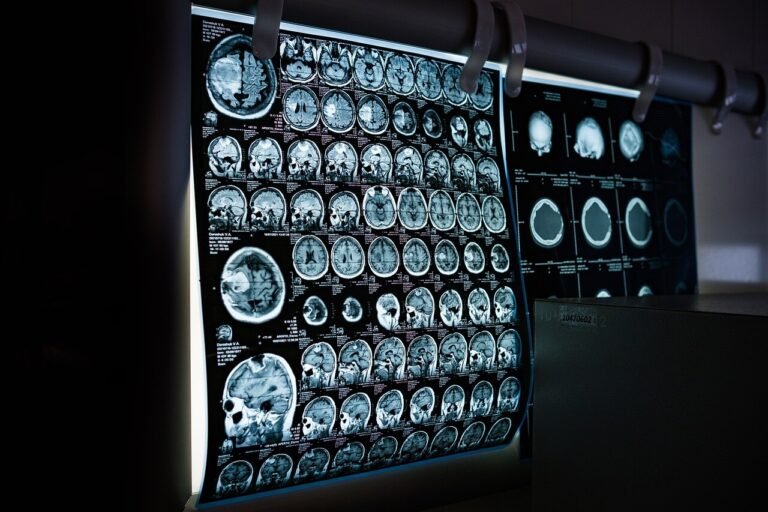
                    Dr. Daniel Amen is a neuropsychiatrist with a vast experience in treating those with ADD.  He uses a particular kind of brain imaging, called Brain SPECT Imaging, which creates three-dimensional models of the brain and demonstrates the level of functioning in different brain regions.  By studying more than 1700,000 people with ADHD and other psychiatric disorders, Dr. Amen discusses in his book ‘Healing ADD‘ that there are in fact seven different types of ADD:

                    Dr Amen’s Seven Types of ADD

                    Is There A Link Between Type 1 Diabetes and AD(H)D?

                    Now, this was the bit that really got me.  I found an article by the  diabetes-focused psychotherapist Eliot LeBow saying that ‘Many people with type 1 diabetes also live with attention-deficit/hyperactivity disorder…’ and ‘those who were diagnosed before age 17 years have some level of ADHD with predominantly inattentive presentation’.  (This ‘inattentive presentation’ referring to Dr. Amen’s ‘type 2’ form of ADD above.)

                    Wow!!  This really resonated with my experience (and self-diagnosis!)!  I dug in further and explored the three references that Eliot cited at the bottom of his article in the journal ‘Endocrine today’…  But then I fell short.  The three articles he cited all referred to the impact of type 1 diabetes on brain development but none of the three articles specifically cited ADHD.  Therefore, the subjects in these studies had not been diagnosed with ADHD per se, even if they exhibited similar cognitive issues.

                    As it turns out, the research into the relationship between ADHD and type 1 diabetes is pretty sparse.  This study set about trying to rectify this and found that, in their study cohort at least, ADHD is associated with Type 2 diabetes but not Type 1. a large population-based study in Sweden found that the rate of ADHD, along with a whole host of other psychiatric disorders, was significantly increased in children diagnosed with type 1 diabetes in the five years prior.

                    An Alternative View Of The Relationship Between ADD And Type 1 Diabetes

                    When I’m reading published studies in the field of diabetes, I am struck by how often the blood sugar levels of the diabetic participants are not taken into account.  Yes, sometimes a measure of the average blood sugar level is taken by means of the HbA1c but I don’t believe that that is a particularly good indicator of anything.  I have spent years going in for diabetic check-ups to be told that my HbA1c is ‘great’.  However, if you were to ask me about my day-to-day blood sugar levels, it’s often more choppy waters than calm seas!  As a result, my mood, my energy and my motivation fluctuate accordingly.  After all, who wants to work when they don’t feel well?!

                    Therefore, I wonder whether the inconclusive findings about any potential correlation between ADD and Type 1 Diabetes might be due to an assumed static position on blood sugar levels.  Perhaps, on the days when your blood sugars just aren’t playing ball and they’re bouncing like they’re on a trampoline, maybe your brain is also likely to not be optimal in its functioning.  However, on the days that you are winning the good fight with your blood sugar levels, maybe your brain functioning is also pretty good.   And no longitudinal or population-based study will pick up that fine detail.  They’re only looking for averages and not the lived experience that the statistics denote.

                    To Diagnose Or To Not Diagnose, That Is The Question!

                    Whilst the picture feels a bit murky to me, wondering whether I might or might not have ADD and whether diabetics have a high or normal likelihood of having it, one thing has become apparent to me.  I could just pop down to see my local psychologist or psychiatrist to get a diagnosis but I’m left feeling that that probably won’t give me very much.  I know that putting myself on medications to increase my level of functioning is a route I wish to take.  I know that, for some, that choice is most definitely worthwhile and fits with their goals in life.  But, for me, I always worry that medicating myself will just mask the underlying condition that needs resolving and leave me stagnated in a place where the possibility of my body, mind and soul to heal themselves disappears.  I want to try to reach for more than that.

                    What I am now seeing in myself are the areas of my functioning that are not particularly strong and need some work or need some support.  At the moment, my sporadic or completely absent motivation is getting in the way of what I need to do on my path to healing.  It’s causing me issues in being able to stay on-track with the nutritional and other changes that I wish to make.  And therefore this is going to be where I will be focusing my energies now.  This is the next bit I need to heal.  And that will be the focus for my next blog post!

                    ADHD Pinterest post

                    GET HEALINGT1D’S FUTURE ARTICLES IN YOUR INBOX!

                    Get the latest musings and findings straight to your email inbox.

                      Picture of Natalie Leader
                      Natalie Leader

                      Natalie is a blogger with Type 1 Diabetes. Natalie’s special gifts are questioning the status quo and being a rebel. She is using these gifts to question medical ‘knowledge’ and find a true cure for Type 1 Diabetes.

                      The content of the HealingT1D website is for educational and information purposes only.  It does not contain medical advice. The contents of this website are not intended to substitute for professional medical advice, diagnosis or treatment. Please always consult with your doctor, physician, or other qualified healthcare professional before making any adjustments to your routine or healthcare regime.  HealingT1D and all associated with it will not be held liable for any risks or issues associated with using or acting upon the information on this site.
                      Recent Comments:
                    • Coronavirus and Type 1 Diabetes

                      Coronavirus and Type 1 Diabetes

                      Heightened Risks And The Added Need For Stable Control

                      The content of the HealingT1D website is for educational and information purposes only.  It does not contain medical advice. The contents of this website are not intended to substitute for professional medical advice, diagnosis or treatment. Please always consult with your doctor, physician, or other qualified healthcare professional before making any adjustments to your routine or healthcare regime.  HealingT1D and all associated with it will not be held liable for any risks or issues associated with using or acting upon the information on this site.
                      healing curing type 1 diabetes naturally
                      Coronavirus has spread throughout the world, putting people with Type 1 Diabetes at increased risk.
                      Summary: Amid the COVID-19 pandemic, the author reflects on the heightened risks faced by Type 1 Diabetics, who are more likely to die from the virus than those without diabetes. Maintaining stable blood sugar levels becomes crucial for bolstering immunity. Adjusting routines and embracing self-forgiveness are vital amidst the challenges of managing diabetes during this global crisis.

                      Yeah, so this happened…!!  The world has been ransacked and people have been left quaking in their boots by the virus that is not-so-affectionately known as COVID-19.

                      It seems like a long time ago now but there was a time when Coronavirus didn’t exist (like, less than a year ago…!!).  In those days, Type 1 Diabetics were ‘just’ battling through their days as best they could with the general level of challenge that this medical condition presents.

                      But, for me now, it feels like a whole new level of challenge has entered my life.  I now have my daughter at home permanently (at least for now!) so time has evaporated and my usual life activities are all on hold.  As such, I anticipate that my blogging will be erratic for a while but please know that I haven’t given up.  I will be dropping in here as often as I can to think, write and respond as best I can.

                      If I have learnt anything during this time, it is about being gentle.  Gentle with my family and friends in this time of stress and uncertainty.  Gentle with myself by lowering my expectations for both myself and others.  At the moment, it is okay to just aim to be what I am.  Anything else can come later.

                      coronavirus type 1 diabetes

                      I did, however, want to try to use this moment to put a few thoughts down about the particular challenges of having Type 1 Diabetes in these Coronavirus times.

                      Increased Risk Of Death For People With Type 1 Diabetes

                      So this is not a heading I ever wanted to write in my blog.  But I think that, at a time like this, honesty and openness about the dangers are important.  If for no other reason, truth can diminish the erratic thoughts that result from out-of-control fear.  They can also offer hope.

                      Early on in the pandemic, at least where I am in the UK, the newspapers circulated information about the risks of death from COVID-19 for various medical conditions.  For diabetics, the statistics were stark reading…

                      What Are The Most Common Health Conditions Among People Who Die Of COVID-19?

                      HEALTH CONDITION % OF TYPE 1 DIABETICS WITH THIS CONDITION
                      Cardiovascular Disease
                      10.5%
                      Diabetes
                      7.3%
                      Chronic Respiratory Disease
                      6.3%
                      Hypertension
                      6%
                      Cancer
                      5.6%
                      No Health Condition
                      0.9%

                      So, according to this, once diabetics have contracted COVID-19, their risk of dying from the disease is greater than people suffering from chronic respiratory disease, hypertension and even cancer!  

                      It was assumed that people with Type 2 Diabetes were generally more at-risk because they are generally older and also often have co-morbid health conditions, making their overall health poorer than those with Type 1 Diabetes.

                      However, a study by the National Health Service in the UK has now published a study that says otherwise…  

                      Type 1 Diabetics Three Times As Likely To Die From COVID-19

                      As shown in this article by the Guardian newspaper, the NHS has found that those with Type 1 Diabetes are three-and-a-half times more likely to die from Coronavirus than non-diabetics.  Type 2 diabetics are ‘only’ twice as likely (note: that’s still a huge increase!).  Of course, the number of actual deaths of Type 1 diabetics will be substantially lower than Type 2s, since Type 2s are so much more numerous in the population.

                      What Is The Takeaway Message?

                      COVID-19 is a dangerous virus for those with Type 1 Diabetes.  Once contracted, death is more likely than for other tranches of the population. 

                      HOWEVER…

                      As I discussed in this blog post, the immune system of Type 1 Diabetics may actually not be compromised.  Only the sub-optimal blood sugar control impacts the immune system.  Therefore, stable blood sugars are our best fight against this disease.  This will enable us to keep our immune system strong and therefore reduce our likelihood of catching COVID-19.  Of course, combining tight blood sugar control with social distancing measures reduces our risks further.

                      Easier Said Than Done…?

                      Perfect blood sugar control when the world has gone to hell in a hand basket seems like a tall ask!  When your whole routine – the thing our diabetic bodies thrive on – has gone out the window, how is that possible?  

                      coronavirus type 1 diabetes

                      I have started by establishing a new routine.  My usual exercise routine is gone and has been replaced by a good hour of walking early in the afternoon each day with my husband and daughter.  I have worked out new meal timings that work not only for me but for my family as a whole.  I am accepting that I have gained some weight, which has increased my total daily units.  I accept that I am unlikely to drop this weight whilst under the stress of this pandemic.  And I am learning to forgive myself for the deviations that I inevitably make in my attempts to keep myself as well as I can.

                      coronavirus and type 1 diabetes

                      GET HEALINGT1D’S FUTURE ARTICLES IN YOUR INBOX!

                      Get the latest musings and findings straight to your email inbox.

                        Picture of Natalie Leader
                        Natalie Leader

                        Natalie is a blogger with Type 1 Diabetes. Natalie’s special gifts are questioning the status quo and being a rebel. She is using these gifts to question medical ‘knowledge’ and find a true cure for Type 1 Diabetes.

                        The content of the HealingT1D website is for educational and information purposes only.  It does not contain medical advice. The contents of this website are not intended to substitute for professional medical advice, diagnosis or treatment. Please always consult with your doctor, physician, or other qualified healthcare professional before making any adjustments to your routine or healthcare regime.  HealingT1D and all associated with it will not be held liable for any risks or issues associated with using or acting upon the information on this site.
                        Recent Comments: